On Halloween morning, the office administrator at Graves, Wraith & Associates discovered that someone had stolen Thursday.
Not the entire day, technically. The attorneys had arrived. The phones had rung. Everyone had been extremely busy. But the work that should have been finished was still waiting.
A partner had spent 20 minutes locating a document. A paralegal had entered the same information into three systems. The administrator herself had spent an hour connecting vendors who all agreed the problem belonged to someone else.
Now it was Friday. Deadlines were approaching. And somewhere above the ceiling tiles, something was laughing.
“Probably the air conditioning,” said a partner.
The “air conditioning” whispered, “Have you tried opening another ticket?”
Six Minutes at a Time
The disturbances started small.
An attachment disappeared into an email thread with 47 replies. A document opened in the wrong version. A time-entry window froze just long enough for an attorney to forget what she had been entering.
With every delay, a pale green mist curled out of a computer and drifted toward the conference room.
Inside, something was taking shape.
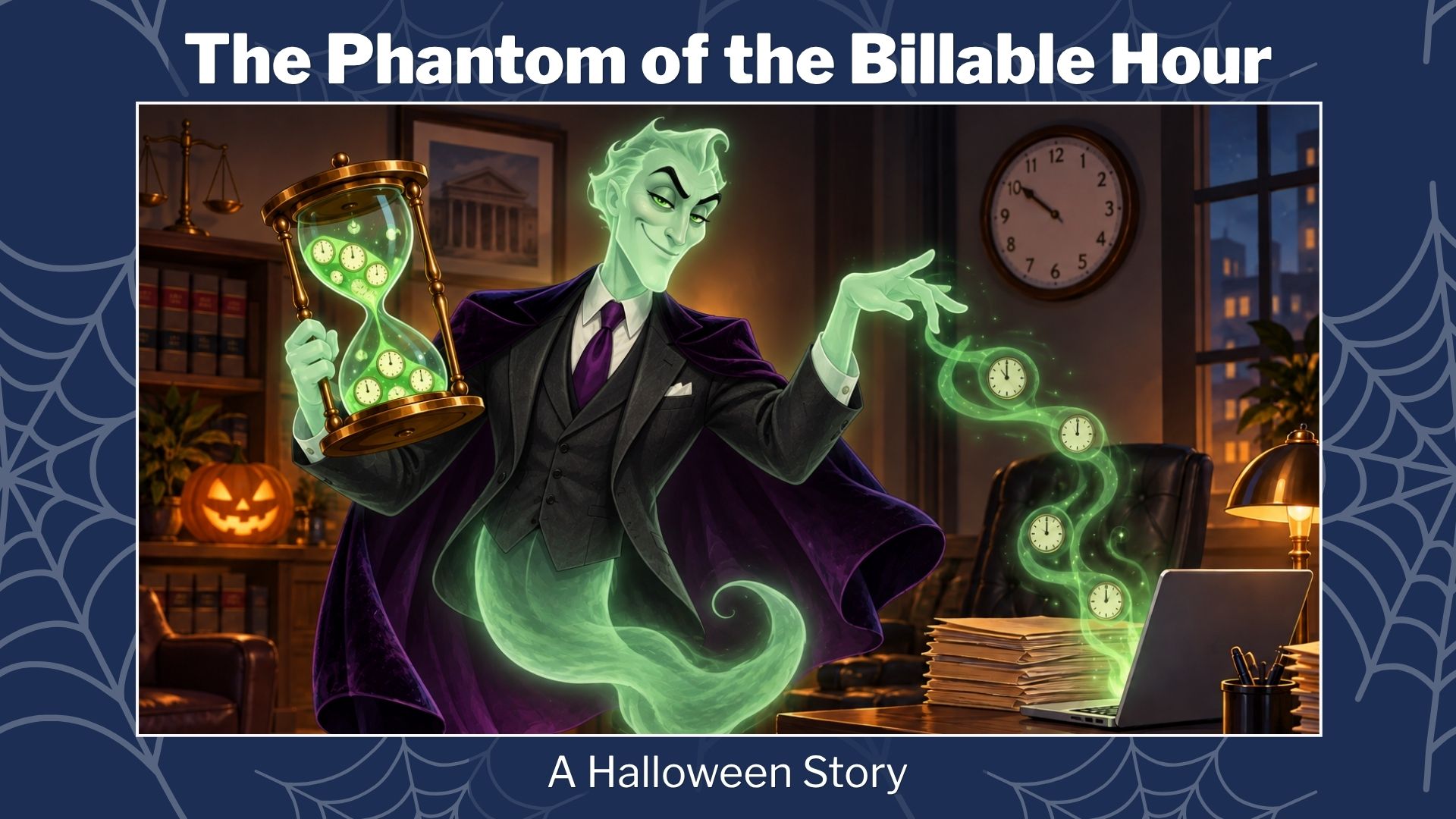
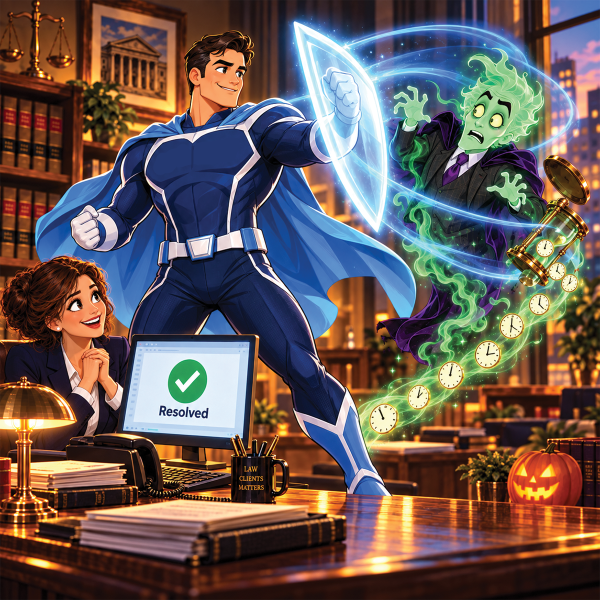
It wore a velvet cape, carried an hourglass and had the deeply satisfied expression of someone who had never completed a timesheet.
“I am the Phantom of the Billable Hour,” it announced. “Collector of lost minutes. Keeper of unfinished work. Patron saint of ‘it usually does that.’”
The administrator folded her arms and asked, “So you’re the reason everyone is working late?”
The phantom tipped its hat and smiled.
“Six minutes here. Twelve minutes there. You’d be amazed what a firm can lose without ever having an outage.”
An associate raised his hand. “Can we bill you?”
“No,” said the phantom. “But I admire the instinct.”
A Firm Full of Hiding Places
The phantom gave them a tour.
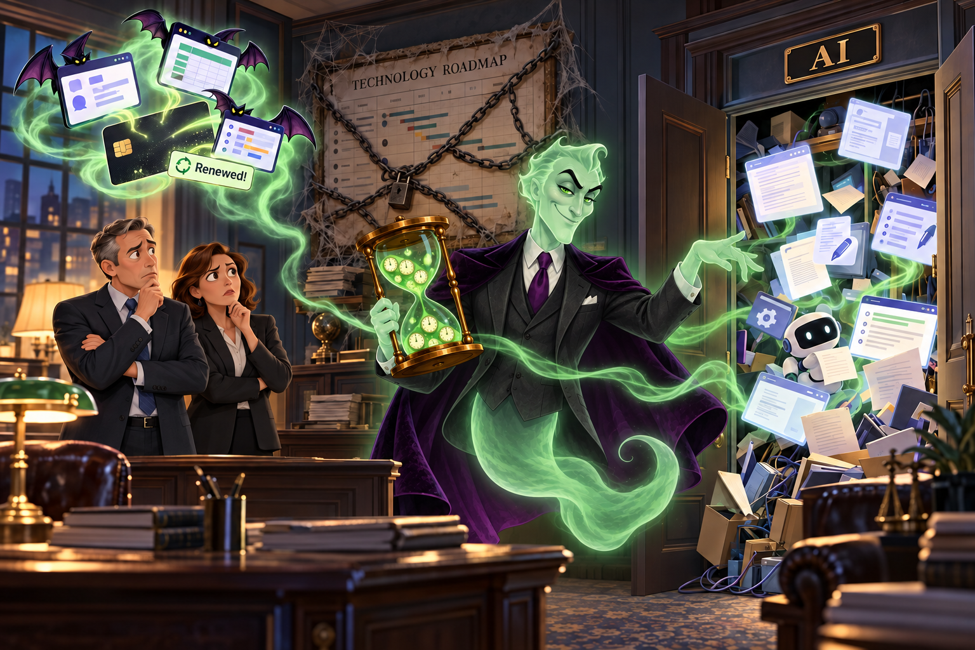
In one office, three nearly identical collaboration tools circled a credit card like hungry bats.
“This one was urgent,” said a partner.
“So was that one,” said another.
The third tool renewed itself with a cheerful ding.
Down the hall, a dusty technology roadmap rattled its chains. Every project had a target date. Several had budgets.
None could explain who was supposed to make the next decision.
“We discussed that in committee,” someone offered.
The phantom inhaled happily. Another ribbon of green mist disappeared into its hourglass.
Then it opened a closet marked “AI.” Out tumbled browser tabs, drafting assistants and a summarization feature nobody remembered turning on.
“I thought we weren’t using AI yet,” said the managing partner.
The closet coughed.
From somewhere inside came a small voice: “Do free trials count?”
A second voice added, “Someone summarized a client memo last week. It went fine. Mostly.”
“Which client?” asked the managing partner.
The closet declined to answer.
“Nobody was hiding anything,” the phantom said cheerfully. “They just had work to do and nowhere to ask.”
Before anyone could answer, an email arrived from a major client asking the firm to explain its security controls.
The administrator looked at the questionnaire. Then at the floating subscriptions. Then at the haunted closet.
“I’m going to need a larger coffee.”
Afinety Enters the Picture
That was when the firm called Afinety.
The team listened as the administrator described the delays, the workarounds and the vendors passing tickets back and forth.
“So,” she finished, “can you help us figure out what’s actually going on?”
“Yes,” said Afinety. “Let’s start with what happens when someone tries to get their work done.”
The phantom lowered its hourglass. It did not care for the direction of this conversation.
Afinety followed a document through the firm’s day: opening it, editing it, saving it, sharing it and recording the time.
They worked with the firm and its vendors to trace the recurring problems. They kept the investigation moving and the administrator informed. For once, she could step away from the support thread without wondering whether anything would happen.
Above the conference table, the phantom’s hourglass developed a crack.
Turning On the Lights
Next, Afinety helped the firm take stock of its applications.
Which tools supported important legal work? Which overlapped? What would happen to active matters and stored documents if something changed?
The useful tools kept their place. Redundant ones received a retirement plan, with the necessary migration and training worked out first.
One subscription bat tried to hide behind an invoice, but the administrator spotted it immediately.
“I’ve been looking for you since budget season,” she said as she canceled it.
The technology roadmap got named owners and realistic priorities. It stopped rattling.
From the AI closet, the team brought existing use into the open. The firm established approved uses, rules for client information and expectations for attorney review. The closet became considerably less crowded.
“People can still use AI?” asked an associate.
“With clear guidance,” said Afinety.
The phantom hissed. It had preferred the uncertainty.
The Phantom Had a Partner
Then the security review found something the phantom had been very quiet about.
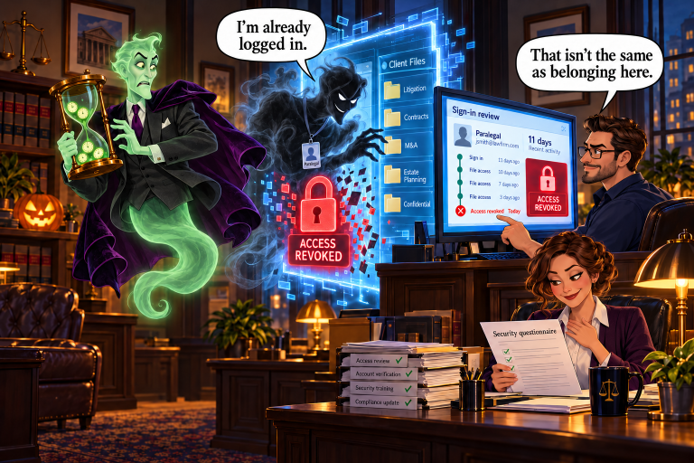
Somebody had been signing in as a paralegal who was on vacation. Not breaking in. Signing in. The account had a valid password, it had cleared multifactor and it had been opening client folders for 11 days.
“I’m already logged in,” the figure said, as though that settled the matter.
“That isn’t the same as belonging here,” said Afinety.
The phantom’s cape rippled. “You were all so busy,” it said. “I only kept everyone looking the other way. I never said I worked alone.”
Afinety investigated the activity, shut down the access and worked with the firm on what needed to change. The hourglass stopped filling.
The administrator returned to the client’s security questionnaire. This time the firm had current documentation and knew who could verify each answer. Her coffee finally had a chance to cool.
Objection: This Haunting Is Over
The phantom retreated to the conference room. Its cape had shrunk. Its hourglass was leaking. The subscription bats had abandoned it.
“You’ll miss me,” it warned. “Who will keep everyone busy?”
“We have clients,” said the administrator.
“Deadlines,” added a paralegal.
“An actual job,” said the managing partner.
The phantom tried one final spell and a glowing button appeared above the table.
BUY ANOTHER TOOL. FIX EVERYTHING.
Nobody clicked.
With a disappointed puff of green smoke, the phantom vanished.
Over the following weeks, Afinety stayed alongside the firm as the improvements took hold. Documents became easier to find. Recurring problems received follow-through. Technology decisions had owners, and staff had clearer guidance on the tools they used.
There was still plenty of legal work. But fewer minutes disappeared between tasks, and fewer evenings were spent catching up on work that should already have been done.
That Halloween, the administrator left in time to take her children trick-or-treating.
As she switched off her monitor, a faint voice whispered from the ceiling: “Just one more workaround?”
She smiled. “Take it up with Afinety,” she said as she headed out the door.
Give Your Firm’s Time a Fighting Chance
Slow systems, scattered tools and unclear responsibilities can quietly take a toll on your people, profitability and client service.
Afinety works with law firms to bring clarity to their technology, strengthen security and provide dependable support from a team that understands legal work.
If your firm’s time keeps disappearing, let’s talk.
You have enough matters to manage without adding a haunting.