
When law firm leaders talk about profitability, the conversation usually starts with rates, billable hours, staffing, realization and collections. All of that matters, but there is another factor sitting underneath those numbers that does not always get the same attention: how easily people can actually get their work done.
If attorneys are waiting on slow systems, hunting for documents, working around clunky processes or losing time to support issues, the firm is not just dealing with an IT problem. It is absorbing small hits to productivity, client service and revenue every day.
That is why IT belongs in the profitability conversation. Technology does not magically create profit, and every operational challenge cannot be fixed with another platform. But a firm’s systems, workflows, support model and security controls do influence how efficiently work moves from effort to invoice to cash.
Profitability depends on more than demand
The legal market has had a strong run, which gives law firm leaders a valuable opportunity: look closely at what is helping profitability and what may be quietly working against it. Thomson Reuters’ 2026 Report on the State of the US Legal Market found that the average law firm saw 13% profit growth in 2025, while also pointing to rising technology spending, talent costs and growing client pressure around value.
That is the kind of moment where operational drag can hide. When demand is up, firms may tolerate slow processes, uneven workflows or support issues because the numbers still look healthy. But profitability is not only about how much work comes in. It is also about how efficiently the firm delivers that work, captures the time, bills it cleanly and collects.
Billable time is easier to lose than leaders think
Most firms can see major downtime. If a system is unavailable for hours, everyone knows it. The harder problem is the quiet kind of friction that never shows up as a single dramatic event.
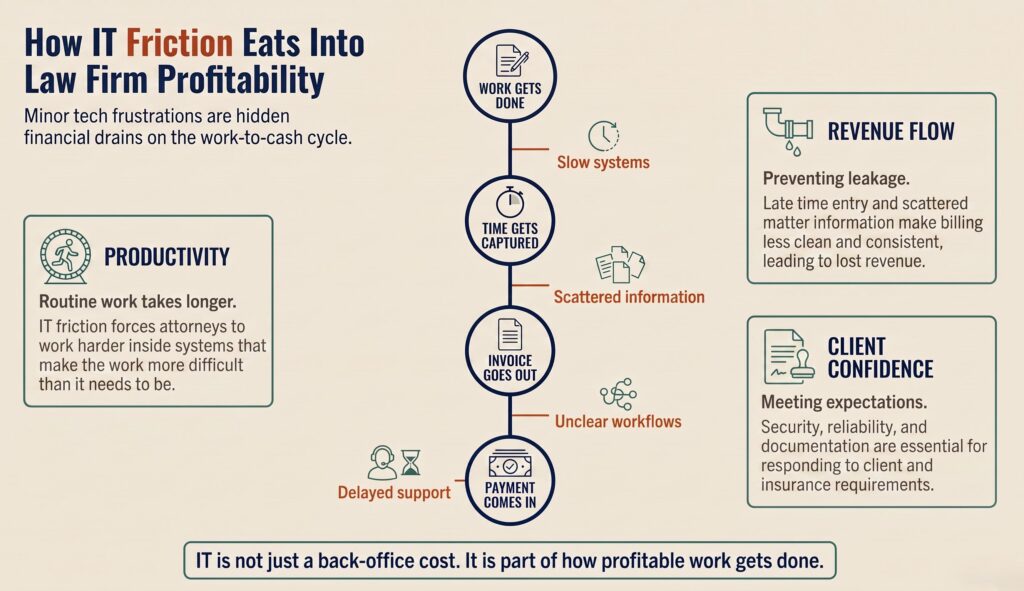
A document takes too long to open. A user cannot find the right matter file. Attorneys use different processes because training was inconsistent. Staff spends time chasing updates that should be visible in the system. None of these issues may feel large on its own, but they repeat across people, matters and days.
The ABA found that 47% of respondents said technology-related problems sometimes have a negative impact on productivity. The impact was even higher among firms with 10-49 attorneys, where 56% reported productivity challenges tied to technology. Firms with 2-9 attorneys reported a similar rate to the overall group, at 47%.
That is worth paying attention to because productivity loss is not always a staffing issue or a motivation issue. Sometimes people are working hard inside systems that simply make the work harder than it needs to be.
Workflow problems become financial problems
Profitability does not depend only on how much time attorneys work. It also depends on how much of that work is captured, billed and collected.
If time is entered late, if work has to be redone or if matter information is scattered across systems, the firm has already lost value before the invoice goes out. The same is true when a partner decides not to bill for time because the process was inefficient or the work took longer than expected. Fragmented systems and unclear workflows can make that kind of revenue leakage harder to avoid.
Stronger document access, easier time capture, consistent processes and responsive support can help reduce friction between work performed and work billed. That does not mean every firm needs more technology. It means the technology already in place needs to support how the firm actually works.
Midsize law firms have less room for operational drag
This issue is especially relevant for midsize law firms. Many are large enough to have complex systems, client demands and security expectations, but not always large enough to absorb inefficiency without feeling it.
Thomson Reuters’ Q1 2026 analysis of midsize law firms found that midsize firms saw slower growth in the rates they earned for client work, while direct expenses rose faster than other law firm segments. That does not mean midsize firms are in a weak position. Many are well-positioned because they offer strong client service, specialized expertise and a more flexible alternative to larger firms.
However, firms of this size need to be intentional about the drag they allow to remain in their business. A slow support model, uneven training or overlapping tools matter more when expenses rise and clients become more value-conscious.
IT affects staffing capacity, too
Technology spend is easy to see. The cost of underusing technology is harder to measure.
A firm may already be paying for tools that could reduce manual work, improve visibility or make collaboration easier. But if people are not trained, if workflows are not standardized or if support is purely reactive, the firm may never get the full value of those systems.
When users do not know how to use the tools in front of them, they create their own processes. Some are harmless. Others create duplicate work, inconsistent data, unnecessary tickets or security concerns. Over time, the firm buys capacity with labor because it has not built enough capacity through process.
Security and continuity protect revenue
Security is often treated as a risk issue, which it is. But for law firms, it is also a revenue protection issue. Clients want to know their information is protected. Insurers want evidence of controls. Firm leaders want confidence that operations can continue if something goes wrong. A security incident, system outage or failed backup process does not only create technical work. It interrupts billable work, absorbs leadership time, creates client communication challenges and can damage trust.
ABA cybersecurity guidance notes that clients and potential clients may ask law firms to complete security questionnaires, provide security documentation or undergo third-party assessments. A firm that cannot clearly explain its controls may face delays in client onboarding, cyber insurance renewals or vendor reviews. A firm that cannot recover quickly from disruption may lose more than time. It may lose confidence.
The better question is not just what IT costs
It is natural for law firm leaders to ask what IT costs. Every firm has to manage spend. But the better question is whether the firm’s technology environment is helping or hurting the economics of the business.
A few questions can help focus the conversation:
- Where are attorneys and staff losing time because systems are slow, disconnected or inconsistent?
- Which workflows create duplicate effort, rework or late time entry?
- Are technology issues being resolved at the root, or only handled one ticket at a time?
- Do attorneys and staff have enough training to use the tools already in place?
- Can the firm respond confidently to client and insurance questions about security?
IT will not replace strong leadership, good client relationships or sound financial management. But it does shape the environment where all of that work happens. When technology is managed only as overhead, firms miss how it affects productivity, consistency, revenue protection and client service.
Afinety helps law firms assess where technology may be creating friction across workflows, support, security and day-to-day operations. For firms looking to protect profitability, the right place to start is often not with another tool, but with a clearer view of where technology is helping the business and where it is quietly getting in the way.