Picture this: a firm 18 months after go-live. The solution is fully deployed, but attorneys are still emailing drafts and saving files to their desktops. The technology worked. The results didn’t.
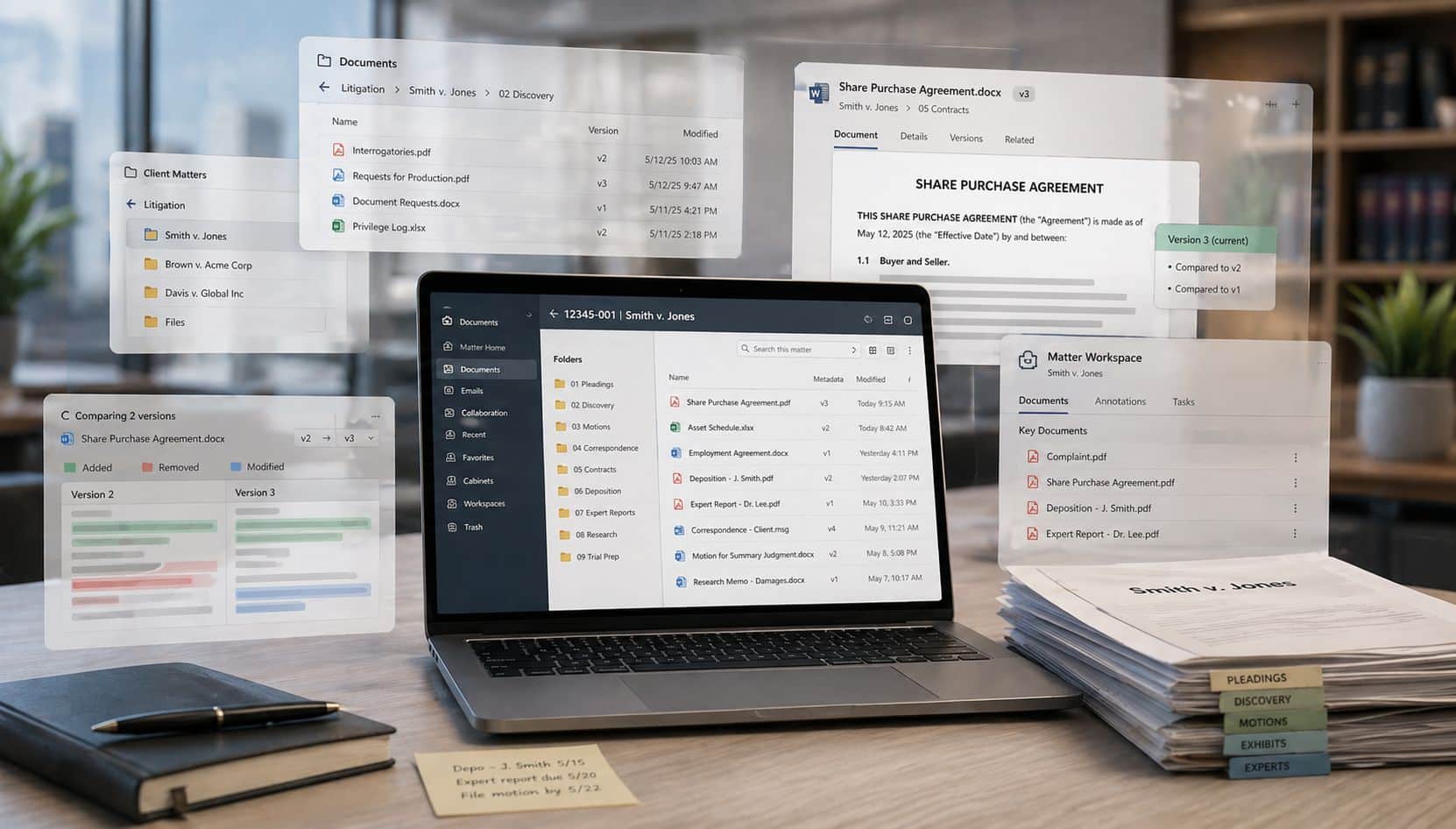
Documents are still stored in multiple places, including the document management system, Outlook, Teams and local desktops, often within the same matter. Attorneys continue to email drafts or save files locally. Staff spend time trying to determine which version of a document is the right one.
The system works. The firm just isn’t using it the way it was designed.
That’s because document management is not just software. It is the operating model for how a firm manages information.
The foundation beneath AI and security
Cloud adoption and document management modernization are no longer emerging trends in the legal industry. They are now standard components of how firms operate.
According to the American Bar Association’s Legal Technology Survey, the majority of law firms use cloud-based tools in some capacity, particularly for document and practice management. At the same time, firms are increasing investments in AI and strengthening cybersecurity programs, both of which depend heavily on how firm data is structured and governed.
Industry research and commentary consistently reinforce the same point: technology alone does not drive results. Adoption, governance and consistency across the firm are what determine whether systems deliver value.
AI requires well-organized, accessible data. Security requires consistent controls and visibility. Both depend on the same foundation: a well-structured document management environment. When that foundation is inconsistent, everything built on top of it becomes harder to manage.
What firms underestimate before implementation
When law firms evaluate cloud platforms or document management systems, most of the attention goes to the technology itself. Features, performance and vendor selection tend to dominate the conversation.
What often receives less attention is the operational design that supports the system. This includes how documents are organized within matters, how workspaces are structured across practice groups and how naming conventions are defined.
It also includes how legacy data is cleaned up and migrated. In many firms, that means identifying duplicates, outdated files and inconsistent naming conventions across legacy file shares.
These are not technical details. They are decisions about how the firm works.
For example, two practice groups may each develop their own folder structures independently during a rollout – one organized by document type, another by timeline. Once the system is live, reconciling those inconsistencies becomes significantly more disruptive than addressing them up front would have been.
Legal technology consultants consistently point to the same root cause: governance and workflow design were deferred until after go-live. By then, fixing them is far more disruptive than getting them right at the onset.
What technology teams see after go-live
From an operational standpoint, most cloud and document management projects succeed at deployment. The solution is live, users have access and the platform performs as expected. But adoption rarely happens evenly across the firm.
Some practice groups follow the intended structure, while others continue using familiar habits. Workarounds begin to appear. Documents are saved outside the system for convenience, email becomes a parallel document-sharing tool and teams create their own variations of organization.
Over time, the same issues that prompted the project begin to return. Search becomes less reliable, version control becomes harder to track and staff spend time trying to locate the authoritative document.
At that point, the environment itself is often blamed. In reality, most of these environments are not broken. They are partially adopted.
Research from the Thomson Reuters Institute’s Future of Professionals Report highlights that many organizations continue to struggle to translate technology investments into consistent, day-to-day usage. When that happens, complexity doesn’t disappear. It shifts.
Search results become less trustworthy. Collaboration becomes less predictable. Time is spent validating information instead of using it.
Many firms recognize these symptoms but struggle to pinpoint the cause. They are not dealing with a technology issue. They are dealing with an operating model that was never fully aligned.
Why environment design matters
Document management systems do not operate in isolation. They are part of a broader technology environment that includes authentication, collaboration tools, storage locations and security controls.
As firms continue moving toward cloud-based environments, the importance of integration and consistency across systems becomes more apparent.
When that environment is fragmented, adoption becomes harder to sustain. Users may have multiple ways to store or access documents, different tools may introduce competing versions of the same file and security policies may be applied inconsistently. For example, a document may be created in one system, shared through another and stored in a third, making it difficult to establish a single source of truth.
In that context, document management becomes one of several options rather than the foundation for how information is handled.
Firms that see stronger adoption tend to align document management with a more consistent environment. Access is predictable, storage locations are clear and workflows are reinforced across systems. That consistency makes it easier for attorneys and staff to work within the system rather than around it. This is why many firms are beginning to approach document management, AI and security as interconnected decisions rather than separate initiatives.
The realities law firms are working within
It’s important to acknowledge that these challenges are not the result of poor decisions or lack of effort. Law firms operate within real constraints.
Firms are balancing client expectations, operational efficiency and ongoing technology investment decisions at the same time. In many firms, different practice groups have developed their own approaches to document management over time, and standardizing those approaches often requires tradeoffs that are difficult to enforce without strong leadership alignment.
These factors make large-scale operational change difficult. As a result, many firms approach document management projects with a focus on minimizing disruption rather than redefining how work is done.
That approach makes rollout easier, but it doesn’t fix the underlying problem. The same issues tend to return, often within a year.
What successful law firms do differently
Firms that see stronger outcomes tend to approach these projects differently. They recognize that document management is not just a system implementation. It is a firmwide operating model decision.
Firms that align technology decisions with workflows and firmwide processes are more likely to see sustained adoption over time.
That shift in perspective leads to different priorities. Firms invest time in aligning workflows before selecting or deploying technology. They define document structures, naming conventions and matter workspace standards early and apply them consistently across practice groups and address legacy data cleanup before migration.
A different way to think about document management
Modern document management platforms are highly capable. Most firms are not struggling because they chose the wrong system.
The gap between technology capability and real-world usage remains a persistent challenge across legal organizations.
They are struggling because the system was introduced into an environment that was not fully aligned around how information should be managed.
That’s why so many firms revisit these projects after implementation, often investing additional time and resources to address issues that were deferred the first time. This often translates into lost time, inconsistent client service and additional internal effort to manage information that was expected to be easier to access.
Cloud and document management initiatives do not succeed because the software is installed. They succeed when the firm decides how consistently it wants to manage its information and aligns its technology, workflows and governance around that decision.
Where to start
Many law firms discover that the hardest part of a cloud or document management initiative is not selecting the technology. It is aligning how the firm actually works with how the system is designed to operate.
The firms that navigate this most effectively treat implementation as two parallel workstreams: one focused on operational design (workflows, governance and requirements) and one focused on the technical environment that makes consistent usage possible. Firms that address both in parallel avoid the rework that comes from treating them as separate phases.
Addressing these issues early can help avoid the need to revisit the same project a year or two later.
If your firm is evaluating or revisiting a document management or cloud initiative: Think of it as two sides of the same initiative: the operational strategy and the technical foundation.
- For help aligning workflows, governance and system selection, connect with 3545 Consulting.
- For help designing, implementing and supporting the cloud environment behind those systems, talk to Afinety.